The Sail Indonesia fleet divided into two groups before we left Darwin - about 70 of the boats elected to take the Western Route while twelve other boats chose the Eastern Route (Northern would have been a better description of the direction but it doesn't matter). When we were anchored off of Kabaena Island, the twelve boats on the Eastern Route divided yet again. The next stop on our itinerary was the village of Bintang on Selayar Island where a traditional Welcome Ceremony was scheduled along with a feast of traditional foods. Selayar Island is about 35 miles long and only a few miles wide at it's widest point - a more pencil-shaped (or insert your own favorite analogy here) island I've never seen. The dilemma was that 30 miles east of Selayar Island is the Taka Bone Rate archipelago with it's pristine beaches and crystal-clear water. If you chose to go to Selayar Island first, it left you facing a 30-mile bash to windward. On the other hand, Selayar Island could be skipped altogether and the sail to Taka Bone Rate would be an easy overnight reach. Our fleet divided almost evenly, those saying that it would be rude to skip the festivities scheduled for us on Selayar while others were saying they had tired of festivities and just wanted a calm, quiet space for a while.
We arrived at the very small island of Tinabo in the northern part of the Taka Bone Rate lagoon, which is almost 60 miles long. The passes into the lagoon are miles wide and entry wasn't an issue. Typical of most of the islands in Indonesia, a wide coral shelf extends out from the beach and then drops off precipitously, making anchoring a challenge. Regardless, our hook grabbed onto something - I couldn't tell what - and held fast although I did have some concerns that I would be able to get it back up again.
This is what we had been hoping for: A tiny island with wide, clean beaches, crystal clear water and a reasonably protected anchorage. On shore, a national parks 'ranger' station also served as a dive center, a massive 'diver-down' flag flying from one of the palm trees. There were no facilities on shore whatsoever but they did have a compressor with which to refill dive tanks. Even though diving isn't one of my favorite pastimes, it is for many cruisers and Tinabo Island was heaven for them. The cost for guided dives worked out to be ridiculously cheap at somewhere around US$6.00 per person for a two-dive day, complete with boat and guide. Many of the most experienced divers said it was some of the best diving ever.
Ruthie and I snorkeled both near the boat and further down the island, seeing brightly-colored fish that we had never seen before. The coral wasn't as bright as we had seen it elsewhere but it was still pristine and the water the temperature of tepid bath water. In the evenings, many of us cruisers would gather on the beach, enjoying cold refreshing beverages while we watched the sun set. It brought back memories of the Tuamotus and Chesterfield Reef.
-----
At 9/3/2013 1:38 AM (utc) Rutea's position was 07°01.70'S 120°37.09'E
----------
radio email processed by SailMail
for information see: http://www.sailmail.com
Monday, September 2, 2013


Segori Island
I make continuous efforts to keep my cynicism in check but after a vicious bout of food poisoning and then an even worse relapse two days later, my interest in attending yet another Indonesian Welcome Ceremony and feast had become, well, cynical. In the Sail Indonesia Guide, it said that the stop at Segori Island was nothing more than a stopover and that no events were planned, however, once we got there, it turns out events were planned and in a big way for the tiny island. Things got off to a rough start as we approached the island and it's absolutely stunning lagoon of crystal-clear water. With the wind blowing between 20 and 25 knots, the boats in our fleet that had already dropped their anchors there were hobby-horsing enough that every once in a while their bows, poorly timing the next wave, plunged right into it. We sailed around to the leeward side of the island where the kind islanders had installed moorings for us. They did the best they could but a 5-gallon bucket filled with cement will not hold a 20-ton ketch, regardless of how much scope is out and they didn't put out much. In fairness to them, we tried two such moorings, dragging one so deep that once we released it, it sank completely out of sight. Even our attempt to set our own anchor failed so we sadly waved farewell to the Segori Islanders and our friends and found a secure anchorage on a nearby island, about 6 miles away. Five other boats in our fleet joined us.
The Indonesians were not deterred by our lack of proximity to the celebration as they recruited the use of the large police launch with it's two 200-horsepower outboards to shuttle people between the big island and the tiny island. I stayed aboard Rutea while Ruthie, Corie and Kyle did their duty, Ruthie stepping forward and delivering the speech on behalf of the cruisers at the ceremony. The islanders delayed the ribbon cutting ceremony of their new solar electric system to coincide with the Sail Indonesia presence. As a token of their appreciation, they island chief and his wife presented Ruthie with a hand-carved paddle.
The following day there was another road trip, this time on the much larger island of Kabaena. We bounced along a dirt road in a modern SUV that belonged to once of the local policemen, winding our way up to a small village where village children had gathered for a sort of dance competition. The kids were in matching costumes, I guess sorted by school or grade and were divided between the Pole Handlers and the Pole Avoiders. There were also the percussionists. The Pole Handlers had 3-meter long bamboo poles that were about 70mm in diameter and they worked in pairs at each end of two bamboo poles. There were four pairs of Pole Handlers on each team and once the music started, they would smack the poles on the ground or slap the poles together, in perfect time to the music. The Pole Avoiders would then dance between the poles in a delicate and extremely graceful manner even when the tempo became almost impossible. Obviously, if one of the Pole Avoiders got out of sync, her ankle or toe would be soundly smacked by the fast moving bamboo poles. Unfortunately for the kids doing this competition, we arrived late and their teachers made them do it all over again for us.
From there we made our way up a steep and rough road to a small village where we were greeted with a Welcome Ceremony and a feast. Corie and Kyle were selected to represent the cruisers at the ceremony although some of the other cruisers didn't get that memo and it kind of turned into a Group Hug kind of thing. I promise that I dutifully took pictures and didn't roll my eyes.
-----
At 9/3/2013 1:36 AM (utc) Rutea's position was 07°01.70'S 120°37.09'E
----------
radio email processed by SailMail
for information see: http://www.sailmail.com
The Indonesians were not deterred by our lack of proximity to the celebration as they recruited the use of the large police launch with it's two 200-horsepower outboards to shuttle people between the big island and the tiny island. I stayed aboard Rutea while Ruthie, Corie and Kyle did their duty, Ruthie stepping forward and delivering the speech on behalf of the cruisers at the ceremony. The islanders delayed the ribbon cutting ceremony of their new solar electric system to coincide with the Sail Indonesia presence. As a token of their appreciation, they island chief and his wife presented Ruthie with a hand-carved paddle.
The following day there was another road trip, this time on the much larger island of Kabaena. We bounced along a dirt road in a modern SUV that belonged to once of the local policemen, winding our way up to a small village where village children had gathered for a sort of dance competition. The kids were in matching costumes, I guess sorted by school or grade and were divided between the Pole Handlers and the Pole Avoiders. There were also the percussionists. The Pole Handlers had 3-meter long bamboo poles that were about 70mm in diameter and they worked in pairs at each end of two bamboo poles. There were four pairs of Pole Handlers on each team and once the music started, they would smack the poles on the ground or slap the poles together, in perfect time to the music. The Pole Avoiders would then dance between the poles in a delicate and extremely graceful manner even when the tempo became almost impossible. Obviously, if one of the Pole Avoiders got out of sync, her ankle or toe would be soundly smacked by the fast moving bamboo poles. Unfortunately for the kids doing this competition, we arrived late and their teachers made them do it all over again for us.
From there we made our way up a steep and rough road to a small village where we were greeted with a Welcome Ceremony and a feast. Corie and Kyle were selected to represent the cruisers at the ceremony although some of the other cruisers didn't get that memo and it kind of turned into a Group Hug kind of thing. I promise that I dutifully took pictures and didn't roll my eyes.
-----
At 9/3/2013 1:36 AM (utc) Rutea's position was 07°01.70'S 120°37.09'E
----------
radio email processed by SailMail
for information see: http://www.sailmail.com
Thursday, August 29, 2013
Still in Pasarwajo
The events continued while we were in Pasarwajo. One of the events that our stay was timed perfectly for was the 12,500-person dance. Apparently, someone got the idea that they wanted to break the record for the most dancers at a single event, had land cleared and leveled and proceeded to round up 12,500 school children and trained them to perform. Unfortunately, I had come down with a vicious bout of food poisoning and was in no shape to attend but Corie went and came back with a remarkable account of the event. Be sure to check out her blog post.
The following day, the schedule called for a land trip to Bao Bao, the capital of Buton Island. A large fleet of late-model minivans were hired to drive us the 40-kilometer trek over to the north side of the island and, of course, our translators came with us. In fact, they never left our side the whole time we were ashore. Bao Bao is a significantly-sized city, complete with flashy new car dealerships and traffic but also with a spectacular view of a large, well-protected bay. Our procession wended our way through the busy city with a two motorcycle cop and one police squad car escort up to the Most Extensive Old Fort in the World, where we were greeted by the mayor and vice-mayor of the city. Once again, we were given seats in the shade while we listened to their speeches and then we were fed. Again. Beautiful women danced while we waited in the buffet line and after lunch we wandered around the old fort, which offered beautiful views of the city and bay.
In the afternoon, the fleet of minivans showed up and took us to various places all over town, allowing us to see and shop at some of the local markets, after which they dropped us off at one of the newer hotels where we were given complimentary rooms in which to freshen up and relax. Ruthie and I turned down the air conditioning to it's lowest setting and took a nap with the luxury of having a blanket on, albeit a thin one. After showering and dressing for dinner, we left our room (our translators were waiting outside our door), drove to a spot on the bay that had been prepared for dinner. Apparently, our presence was a big deal and it seemed like most of the higher-ranking Bao Bao city officials and their wives in had been invited. An enormous spread of food was laid out, along with more pretty girls dancing and it was followed by speeches. Before we left, we lined up to receive a gift bag from the mayor and vice-mayor and to say our good-byes.
It was almost midnight by the time we got back to Pasarwajo but in the area where the original pavilions had been set up (which had been cleared), fresh pavilions were set up, along with a band. Another spread of food was put out but this time it came with cases of beer and whiskey. Our translators insisted on dancing with us while a big group of locals sat patiently waiting their turn at the buffet. If I had been smarter, I would have refused all food because I could feel a relapse of food poisoning coming on so we decided to leave at the height of the party. Our translators broke into tears as we said good-bye.
-----
At 8/29/2013 1:08 AM (utc) Rutea's position was 06°34.32'S 121°05.60'E
----------
radio email processed by SailMail
for information see: http://www.sailmail.com
The following day, the schedule called for a land trip to Bao Bao, the capital of Buton Island. A large fleet of late-model minivans were hired to drive us the 40-kilometer trek over to the north side of the island and, of course, our translators came with us. In fact, they never left our side the whole time we were ashore. Bao Bao is a significantly-sized city, complete with flashy new car dealerships and traffic but also with a spectacular view of a large, well-protected bay. Our procession wended our way through the busy city with a two motorcycle cop and one police squad car escort up to the Most Extensive Old Fort in the World, where we were greeted by the mayor and vice-mayor of the city. Once again, we were given seats in the shade while we listened to their speeches and then we were fed. Again. Beautiful women danced while we waited in the buffet line and after lunch we wandered around the old fort, which offered beautiful views of the city and bay.
In the afternoon, the fleet of minivans showed up and took us to various places all over town, allowing us to see and shop at some of the local markets, after which they dropped us off at one of the newer hotels where we were given complimentary rooms in which to freshen up and relax. Ruthie and I turned down the air conditioning to it's lowest setting and took a nap with the luxury of having a blanket on, albeit a thin one. After showering and dressing for dinner, we left our room (our translators were waiting outside our door), drove to a spot on the bay that had been prepared for dinner. Apparently, our presence was a big deal and it seemed like most of the higher-ranking Bao Bao city officials and their wives in had been invited. An enormous spread of food was laid out, along with more pretty girls dancing and it was followed by speeches. Before we left, we lined up to receive a gift bag from the mayor and vice-mayor and to say our good-byes.
It was almost midnight by the time we got back to Pasarwajo but in the area where the original pavilions had been set up (which had been cleared), fresh pavilions were set up, along with a band. Another spread of food was put out but this time it came with cases of beer and whiskey. Our translators insisted on dancing with us while a big group of locals sat patiently waiting their turn at the buffet. If I had been smarter, I would have refused all food because I could feel a relapse of food poisoning coming on so we decided to leave at the height of the party. Our translators broke into tears as we said good-bye.
-----
At 8/29/2013 1:08 AM (utc) Rutea's position was 06°34.32'S 121°05.60'E
----------
radio email processed by SailMail
for information see: http://www.sailmail.com
Thursday, August 22, 2013
Pasarwajo, Buton Island
Before we left Darwin, we had been told that schedules, amongst other things, often change quickly in Indonesia so we weren't surprised when we were told that our stop at Ereke on Buton Island was canceled. We had wanted to see Hoga Island anyway and now we had a few extra days before we were scheduled to be in Pasawjaro, also on Buton Island. Our sail from Hoga Island was delightful and we flew the spinnaker almost the entire way, arriving in the late afternoon. A police speedboat showed us to a mooring (which we had been told had been installed for the Sail Indonesia fleet) and we were hardly settled in when a call came over the VHF asking for all participants to please come into shore for the Welcome Ceremony.
All of us cruisers formed a line and some men in very traditional garb did a short dance. Very attractive young women put scarves decorated with fake flowers around each of our necks. In a large, open area, tables under pavilions for shade were set up and around the perimeter were stalls offering goods and services. The place definitely had a festival feeling but it was all set up for the participants of Sail Indonesia. An entire army of interpreters were assigned but they also served as waiters who brought us beer and soft drinks along with local delicacies. After talking, eating and drinking for a while, we started to peruse the stalls that surrounded us. There were many things for sale but whenever we attempted to buy something, we were told that it was free. Several times I'd see a package of something and ask what it was only to have the proprietor of the stall tear open the package, offer me a sample and then insist that I take it with me, refusing any payment. We were flabbergasted. We came back to the boat overloaded with delicious food, including some very potent palm wine.
In order to secure the area for our boats, the Indonesian Navy had a detail on patrol of our boats 24/7. The Indonesian government made arrangements to have our laundry done at no charge. The translators who were assigned to us apparently had been told that they were to be at our beck and call. It was extremely important to them that nothing bad happened to anyone while we were here.
This morning there were two separate celebrations going on simultaneously. One of them had to do with babies and there were about 1,000 of them with their parents. The other was an ancient celebration of warriors returning from victory. As soon as we came ashore, we were directed to a large tent where all the participants of Sail Indonesia were dressed in traditional clothes. I tend to overheat easily and it doesn't take much effort before I'm soaked in perspiration but wrap me in a sarong and put a long-sleeved black coat on me while I'm less than 300 miles from the equator and it will be a good test of my body's cooling system. We were given front seats under a large shaded area and began to wait for the speeches to begin. A steady stream of people would come by to take our picture, some sitting with us so they could have their picture taken with the White People. The governor of Sulawesi spoke and then the Minister of Tourism, who gave a part of her speech in English. Obviously, I couldn't understand any of what she said that was in Indonesian but it was pretty clear that she was telling the people of Pasarwajo not to screw things up for the participants of Sail Indonesia.
After the speeches were over, we made our way, albeit slowly as we couldn't walk more than a few feet before someone would stop us to have their picture taken with us, to another large shaded area that was packed with thousands of people. Our translators did their best to keep a path clear for us but there were just too many people. Fortunately, we came to a place where the path was lined on each side with police and we could make our way without being accosted by photograph seekers.
Under the shade, the ground was covered with rugs. On each rug was a very attractive young woman or two and it appeared that they were being chaperoned by their mothers. In front of each of them was an enormous bowl filled with all sorts of local delicacies. As we made our way down these long lines of pretty girls and their delicious foods, we were constantly being yelled at to sit and eat. All of the food was carefully wrapped to keep away flies but as soon as we sat down at a random rug, the covers would come flying off and the pretty girl would fix a plate of food. If that wasn't amazing enough, she would then feed you just like a mother feeds a baby. Clearly, we were celebrities and everyone wanted us to sit on their rug, feed us and have their picture taken with us.
It was a mind-blowing experience and the only bad part about it was that the battery in our point-and-shoot camera died and I only had my big telephoto on my SLR so I missed a lot of great shots. On the other hand, I will never forget shuffling through long rows of fabulous food and being fed by pretty girls.
-----
At 8/22/2013 10:49 AM (utc) Rutea's position was 05°30.69'S 122°50.81'E
----------
radio email processed by SailMail
for information see: http://www.sailmail.com
All of us cruisers formed a line and some men in very traditional garb did a short dance. Very attractive young women put scarves decorated with fake flowers around each of our necks. In a large, open area, tables under pavilions for shade were set up and around the perimeter were stalls offering goods and services. The place definitely had a festival feeling but it was all set up for the participants of Sail Indonesia. An entire army of interpreters were assigned but they also served as waiters who brought us beer and soft drinks along with local delicacies. After talking, eating and drinking for a while, we started to peruse the stalls that surrounded us. There were many things for sale but whenever we attempted to buy something, we were told that it was free. Several times I'd see a package of something and ask what it was only to have the proprietor of the stall tear open the package, offer me a sample and then insist that I take it with me, refusing any payment. We were flabbergasted. We came back to the boat overloaded with delicious food, including some very potent palm wine.
In order to secure the area for our boats, the Indonesian Navy had a detail on patrol of our boats 24/7. The Indonesian government made arrangements to have our laundry done at no charge. The translators who were assigned to us apparently had been told that they were to be at our beck and call. It was extremely important to them that nothing bad happened to anyone while we were here.
This morning there were two separate celebrations going on simultaneously. One of them had to do with babies and there were about 1,000 of them with their parents. The other was an ancient celebration of warriors returning from victory. As soon as we came ashore, we were directed to a large tent where all the participants of Sail Indonesia were dressed in traditional clothes. I tend to overheat easily and it doesn't take much effort before I'm soaked in perspiration but wrap me in a sarong and put a long-sleeved black coat on me while I'm less than 300 miles from the equator and it will be a good test of my body's cooling system. We were given front seats under a large shaded area and began to wait for the speeches to begin. A steady stream of people would come by to take our picture, some sitting with us so they could have their picture taken with the White People. The governor of Sulawesi spoke and then the Minister of Tourism, who gave a part of her speech in English. Obviously, I couldn't understand any of what she said that was in Indonesian but it was pretty clear that she was telling the people of Pasarwajo not to screw things up for the participants of Sail Indonesia.
After the speeches were over, we made our way, albeit slowly as we couldn't walk more than a few feet before someone would stop us to have their picture taken with us, to another large shaded area that was packed with thousands of people. Our translators did their best to keep a path clear for us but there were just too many people. Fortunately, we came to a place where the path was lined on each side with police and we could make our way without being accosted by photograph seekers.
Under the shade, the ground was covered with rugs. On each rug was a very attractive young woman or two and it appeared that they were being chaperoned by their mothers. In front of each of them was an enormous bowl filled with all sorts of local delicacies. As we made our way down these long lines of pretty girls and their delicious foods, we were constantly being yelled at to sit and eat. All of the food was carefully wrapped to keep away flies but as soon as we sat down at a random rug, the covers would come flying off and the pretty girl would fix a plate of food. If that wasn't amazing enough, she would then feed you just like a mother feeds a baby. Clearly, we were celebrities and everyone wanted us to sit on their rug, feed us and have their picture taken with us.
It was a mind-blowing experience and the only bad part about it was that the battery in our point-and-shoot camera died and I only had my big telephoto on my SLR so I missed a lot of great shots. On the other hand, I will never forget shuffling through long rows of fabulous food and being fed by pretty girls.
-----
At 8/22/2013 10:49 AM (utc) Rutea's position was 05°30.69'S 122°50.81'E
----------
radio email processed by SailMail
for information see: http://www.sailmail.com
Sunday, August 18, 2013
Hoga Island
Our departure from Wakatobi was not without some emotion. Albeit our stay was only about 5 days, a group of girls had become very attached to Corie and Kyle so saying good-bye was difficult for them. Tears streamed down their faces and they mopped them up with the ends of their veils. Of course, saying good-bye has become routine to Corie so she was pretty blasé about the whole thing. Ruthie and I missed saying good-bye to the woman who served as our translator but she sent us a text message on our cell phone that she, too, cried when we left. Maybe they were just so happy we were leaving . . .
The short passage to Hoga Island was uneventful and even though we had 15 knots of wind, it was right on the nose so we had to motor the whole way. I have been feeling very stingy with our fuel, despite the fact that the Indonesian government gave each boat who took this route 200 liters of diesel. It was meant to be a motivating factor to get more boats to take this route but I think everyone who came this way would have done it regardless. We join the rest of the fleet when we get to Lubuan Bajo, near Komodo Island. That's where the Komodo Dragons live. At that time, we'll no longer be in a fleet of 14 boats but rather in a fleet of 87 boats. Frankly, that's one aspect I'm not particularly looking forward to.
Hoga Island is small and low, covered with thick tropical vegetation. A wide reef extends about a half-mile from shore and then promptly drops off to over 500 feet deep. Finding a place to anchor was a little bit of a challenge. The water is very clear and warm with millions of brightly-colored tropical fish. Yesterday while snorkeling, we spotted a black and white banded sea snake, one of the most venomous of anything on the planet. They rarely attack unless provoked but they are very curious and if you try to swim away, they'll follow you.
We are in the company of five other boats, the others in our little fleet choosing to stay in Wakatobi a bit longer. Last night we had cocktails aboard Rutea and it was very much fun. The anchorage is a little exposed for my liking but the wind had died to a light breeze which kept the water flat and the air cooler. I think we might move on to Buton Island tomorrow and maybe even get some internet. These blog posts must be pretty boring without any pictures!
-----
At 8/18/2013 11:48 PM (utc) Rutea's position was 05°28.82'S 123°46.03'E
----------
radio email processed by SailMail
for information see: http://www.sailmail.com
The short passage to Hoga Island was uneventful and even though we had 15 knots of wind, it was right on the nose so we had to motor the whole way. I have been feeling very stingy with our fuel, despite the fact that the Indonesian government gave each boat who took this route 200 liters of diesel. It was meant to be a motivating factor to get more boats to take this route but I think everyone who came this way would have done it regardless. We join the rest of the fleet when we get to Lubuan Bajo, near Komodo Island. That's where the Komodo Dragons live. At that time, we'll no longer be in a fleet of 14 boats but rather in a fleet of 87 boats. Frankly, that's one aspect I'm not particularly looking forward to.
Hoga Island is small and low, covered with thick tropical vegetation. A wide reef extends about a half-mile from shore and then promptly drops off to over 500 feet deep. Finding a place to anchor was a little bit of a challenge. The water is very clear and warm with millions of brightly-colored tropical fish. Yesterday while snorkeling, we spotted a black and white banded sea snake, one of the most venomous of anything on the planet. They rarely attack unless provoked but they are very curious and if you try to swim away, they'll follow you.
We are in the company of five other boats, the others in our little fleet choosing to stay in Wakatobi a bit longer. Last night we had cocktails aboard Rutea and it was very much fun. The anchorage is a little exposed for my liking but the wind had died to a light breeze which kept the water flat and the air cooler. I think we might move on to Buton Island tomorrow and maybe even get some internet. These blog posts must be pretty boring without any pictures!
-----
At 8/18/2013 11:48 PM (utc) Rutea's position was 05°28.82'S 123°46.03'E
----------
radio email processed by SailMail
for information see: http://www.sailmail.com
Thursday, August 15, 2013
We had initially planned for our passage from the Banda Islands
to Wangiwangi Island would take a full three days but
favorable winds and calm seas teased us with the possibility of making it in
two days. Despite all of our sail
adjustments, we arrived at our destination just an hour past sunset and
navigating the short but impossibly narrow pass into the lagoon seemed out of
the question. The local staff for Sail
Indonesia stepped up and offered to guide us in using a small runabout. The night was pitch black and the pass has no
navigation lights but we made it in without too much drama. At one point, someone gave me the command to
‘Turn right!’ while at the exact same moment someone else said ‘Turn left!’. After looking at the pass in the day light, its
amazing that we made it in without hitting anything.

We hit the small town of Wakatobi early the next morning as Sail
Indonesia had our day full of planned events.
Almost 30 cruisers crammed into steaming hot buses and drove out to the
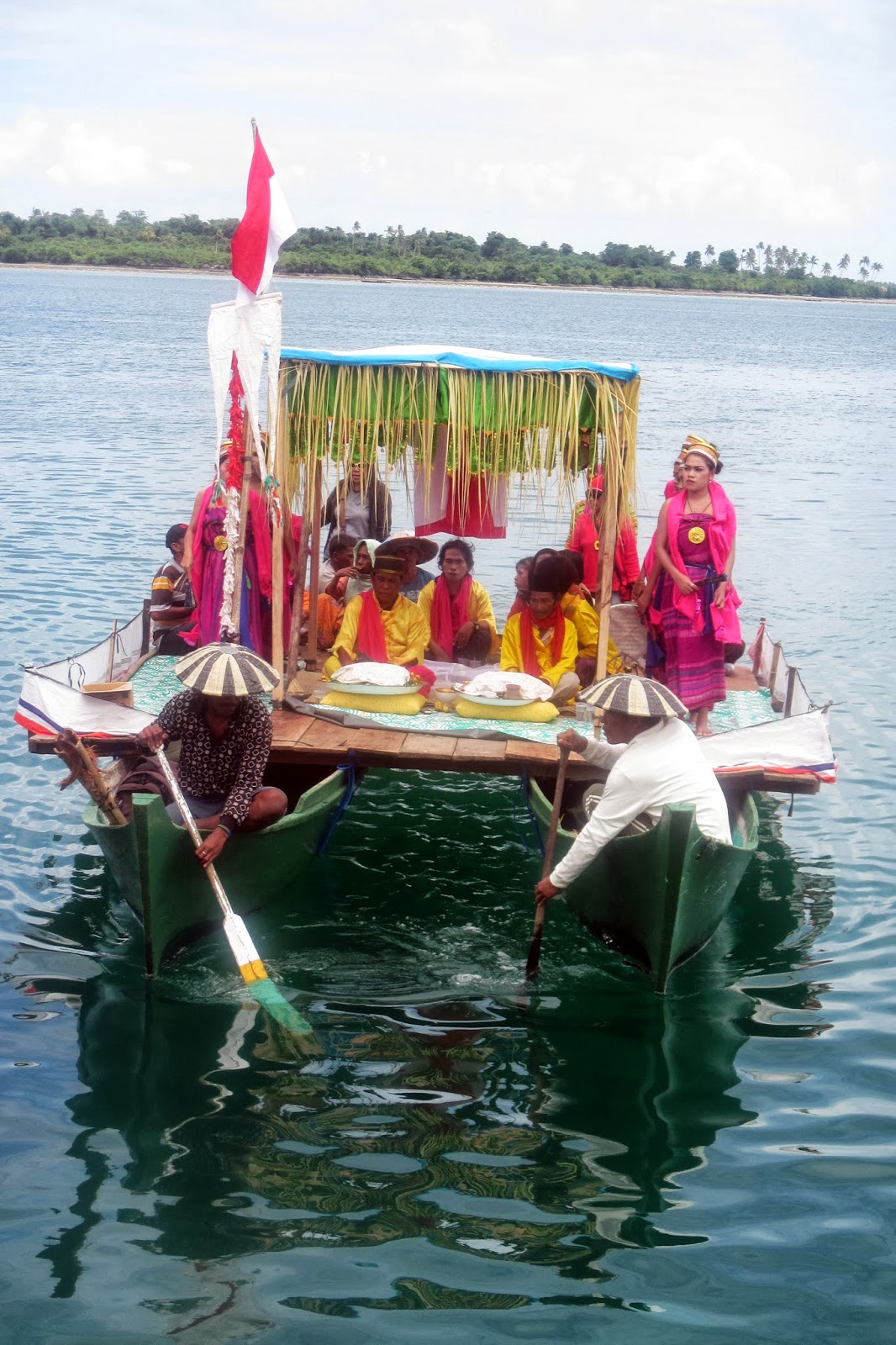
Bajo where thousands of people live on houses built above the water. We went to see a traditional dance where
attractive young women arrive by boat, their dance hopefully warding off
disease. Sail Indonesia had arranged to have a
whole battalion of English-speaking locals to serve as our interpreters and
there seemed to be a competition amongst them to see who could get closer to
the cruisers. Thousands of people turned
out to see the beautiful women dancing and when Ruthie commented on how many
people came to see this, one of our interpreters, Ade, said the people turned
out to see the white people. We were
continuously asked to pose for photographs and people would giggle as they
looked at the results on their smart phones and digital cameras. We were given seats of honor and later fed a
traditional meal while many of the locals watched us eat.

That evening we again climbed aboard the buses and drove out
to a very upscale resort for a welcome dinner, complete with more beautiful
dancing girls. Many of the participants
in Sail Indonesia were asking each other, “How can they keep entertaining us
like this?” In addition to all the food
and programs, they also gave each boat in the fleet 200 liters of diesel
(called ‘Solar’ in Indonesia
– gasoline is called ‘benzene’).

On the following day, we once again piled into buses and
headed out to yet another village, this time to watch Boys and Young Men
Kicking. The village has this tradition
that once a year, in an effort to end any lingering animosities, boys and young
men join in teams of two and kick each other.
Its done with good intentions and most of the time those who are kicking
at each other have smiles on their faces yet there were times when it seemed to
get out of hand and the huge crowd that had gathered to watch would run,
screaming to get out of the way. Once
again, we were given chairs to sit in under shade, fed a meal, while the locals
stood in the hot sun and watched us. On
our way back, we came upon a procession that was blocking the road with
hundreds of people. Litters made of
bamboo were being carried by strong men and in the litters were young women,
dressed in bright silk with impossible head pieces, who were being shown as
possible candidates for marriage, or at least, something to that effect. Some of the girls could not have been 8 or 9
so its possible that something got lost in translation.
Last night, we were invited to the house of one of our
interpreters, Ade. She rounded up
volunteers to drive us to her home on their motorcycles and she and her
husband, Jali, served us a traditional meal of fish and rice. We sat on a rug in their kitchen, under a
single dim light bulb that hung from the ceiling. Their generosity was overwhelming. As I was saying goodbye to Ade, she said to
me, “I hope you weren’t disappointed with my home.” It almost brought tears to my eyes as I
assured her that it had been an honor and a memory that we’ll never forget.
Thursday, August 8, 2013
Banda Islands, Indonesia
The seas were a bit lumpy for our passage from Saumlaki to the Banda Islands but, other than that, we had near-perfect conditions. We covered the slightly more than 180 miles in around 30 hours which was no speed record but certainly well within our expectations. As usual for being this close to the equator (we're at 4 degrees South or about 270 miles south of the equator), the weather is hot and humid, the skies are frequently filled with squall-producing rain. The Banda Islands rise from the very deep ocean floor almost straight up and the steep sides of the still active volcano makes finding a place to drop the anchor a challenge. Everything is covered in thick, dark green tropical vegetation and groves of bananas, papaya, breadfruit, almonds and, of course, nutmeg, cover the six-island group.
There were 5 boats in our 14-boat fleet already here when we pulled into the harbor and our friends on Equanimity helped us Med-moor to the hotel's wharf. Rutea's anchor is some 300 feet out in the channel in over 125 feet of water and her stern sits just a few feet from the shore but still in 25 feet of water. Two thick dock lines run to shore, one tied to a stout tree but both have frisbees attached to them that I converted into rat guards. A representative from Sail Indonesia was on hand to welcome us and someone else took care of the clearing in process.
The town itself is small and busy with narrow streets that are swarmed by people riding motor scooters. Many of the buildings reflect the architecture from when the Dutch took over the islands and dominated the spice trade in the early 17th century. Typical of many Western countries at that time, the Dutch took whatever they wanted while often putting the indigenous people into near slavery. At one point the Indonesian people revolted against their Dutch occupiers and as punishment, the local head of the Dutch East India Company ordered a massacre of thousands of Bandanese. He hired Japanaese samurai to execute the 40 chiefs publicly and this was recently confirmed by a PhD candidate who was researching the islands and found records that the Dutch had kept. In 2002, a monument was erected in memorial to those who were killed back then - over 400 years ago.
Last night was the end of Ramadan and it was the first time any of us had been in a predominantly Muslim country for the end of the month-long fasting ritual. The skies were filled with fireworks and firecrackers made the whole area sound like a war zone. On a normal day, the muezzin - call to prayer - happens five times a day: Recordings of chanting blaring out over massive speakers that can be heard from everywhere in the town. Since today was special, the recordings started their blaring at 0430 instead of the normal 0500 and they went nonstop until 0730 - it sounds like their speakers are in Rutea's cockpit. Today, everything is shut down and its similar to Christmas in the West - families get together, exchange small gifts and eat traditional foods. We walked through town to find many people out on the streets, all wearing fine new clothing. Children walking towards us would stop us and press the backs of our hands to their foreheads. Our reply was to then touch our heart. It was an extraordinary experience.
Our schedule has us leaving Banda on Saturday and heading some 400 miles west to the island of Wangiwangi where Jacques Cousteau once said that the area had the best diving in the world. The forecast is for light winds which will probably make it a comfortable ride but bad because it uses our precious diesel. Diesel here is called Solar and is hard to find - when it is found, its often contaminated.
Despite the lack of diesel fuel and the island's troubling past with the Dutch, the people here are delightful and the area is gorgeous. We went snorkeling expedition this afternoon at a spot not far from where Rutea is tied up and we were all pleased to find world-class snorkeling. After some of the over-the-top snorkeling we've done in the South Pacific, we can be pretty critical of the underwater landscape. This place is fantastic. Too bad we don't have decent internet access so I can post some photos. They're unbelievable.
-----
At 8/6/2013 10:01 AM (utc) Rutea's position was 04°31.43'S 129°53.83'E
----------
radio email processed by SailMail
for information see: http://www.sailmail.com
There were 5 boats in our 14-boat fleet already here when we pulled into the harbor and our friends on Equanimity helped us Med-moor to the hotel's wharf. Rutea's anchor is some 300 feet out in the channel in over 125 feet of water and her stern sits just a few feet from the shore but still in 25 feet of water. Two thick dock lines run to shore, one tied to a stout tree but both have frisbees attached to them that I converted into rat guards. A representative from Sail Indonesia was on hand to welcome us and someone else took care of the clearing in process.
The town itself is small and busy with narrow streets that are swarmed by people riding motor scooters. Many of the buildings reflect the architecture from when the Dutch took over the islands and dominated the spice trade in the early 17th century. Typical of many Western countries at that time, the Dutch took whatever they wanted while often putting the indigenous people into near slavery. At one point the Indonesian people revolted against their Dutch occupiers and as punishment, the local head of the Dutch East India Company ordered a massacre of thousands of Bandanese. He hired Japanaese samurai to execute the 40 chiefs publicly and this was recently confirmed by a PhD candidate who was researching the islands and found records that the Dutch had kept. In 2002, a monument was erected in memorial to those who were killed back then - over 400 years ago.
Last night was the end of Ramadan and it was the first time any of us had been in a predominantly Muslim country for the end of the month-long fasting ritual. The skies were filled with fireworks and firecrackers made the whole area sound like a war zone. On a normal day, the muezzin - call to prayer - happens five times a day: Recordings of chanting blaring out over massive speakers that can be heard from everywhere in the town. Since today was special, the recordings started their blaring at 0430 instead of the normal 0500 and they went nonstop until 0730 - it sounds like their speakers are in Rutea's cockpit. Today, everything is shut down and its similar to Christmas in the West - families get together, exchange small gifts and eat traditional foods. We walked through town to find many people out on the streets, all wearing fine new clothing. Children walking towards us would stop us and press the backs of our hands to their foreheads. Our reply was to then touch our heart. It was an extraordinary experience.
Our schedule has us leaving Banda on Saturday and heading some 400 miles west to the island of Wangiwangi where Jacques Cousteau once said that the area had the best diving in the world. The forecast is for light winds which will probably make it a comfortable ride but bad because it uses our precious diesel. Diesel here is called Solar and is hard to find - when it is found, its often contaminated.
Despite the lack of diesel fuel and the island's troubling past with the Dutch, the people here are delightful and the area is gorgeous. We went snorkeling expedition this afternoon at a spot not far from where Rutea is tied up and we were all pleased to find world-class snorkeling. After some of the over-the-top snorkeling we've done in the South Pacific, we can be pretty critical of the underwater landscape. This place is fantastic. Too bad we don't have decent internet access so I can post some photos. They're unbelievable.
-----
At 8/6/2013 10:01 AM (utc) Rutea's position was 04°31.43'S 129°53.83'E
----------
radio email processed by SailMail
for information see: http://www.sailmail.com
Subscribe to:
Posts (Atom)